Traditional Thai Chicken Pad Thai Recipe with Tamarind Glaze
Jump to Section
The first time I watched a Bangkok street vendor build pad thai along Charoen Krung Road, I realized home cooks have been taught all the wrong instincts. The vendor never touched a pot of boiling water. Behind his roaring burner sat wide basins of cool water where flat rice noodles rested until supple. His ladle moved in rhythmic arcs, caramelizing dense palm sugar directly against the steel before deglazing the wok with tart tamarind pulp. In less than two minutes, translucent noodles emerged glossy, chewy, and completely separate, without a single clump in sight.
Recreating that genuine street cart texture in my own kitchen came down to testing the starch threshold of the noodle. Dried rice noodles do not need boiling water. Boiling fills the porous starch channels with water before the pasta ever touches the wok, causing the noodles to shed steam and glue themselves together under high heat. Soaking them in cool water hydrates the amylose core partially while leaving its absorption capacity intact. The noodles finish cooking inside the bubbling tamarind glaze, drinking in the savory palm sugar syrup while maintaining a resilient, springy bite. If you want to explore the foundational curries, pestles, and wok techniques that define Thai cooking, explore our ++complete Thai culinary guide++ before you fire your burner.
Mid Century Nationalist Modernization Created Pad Thai as a National Dish
Many people assume pad thai is an ancient rural culinary tradition handed down through centuries of Siamese history. It is actually a carefully engineered creation from the nineteen thirties and nineteen forties.
Prime Minister Plaek Phibunsongkhram launched a sweeping national modernization program to establish a strong Thai cultural identity. Thailand faced severe domestic rice shortages caused by catastrophic flooding and World War II economic disruptions.
Whole rice grains were urgently needed for valuable export currency. Producing dried rice noodles required broken rice remnants and consumed significantly less whole grain per meal.
To reduce rice consumption, the Thai government created a standardized noodle stir fry recipe that blended Chinese noodle techniques with distinctly Siamese flavors like tamarind, palm sugar, and fish sauce. The Department of Public Health printed recipe pamphlets and subsidized mobile street carts across the nation, making pad thai an overnight sensation celebrated across our ++Thai recipe collection++.
Dark Amber Palm Sugar Caramelization Generates Volatile Aromatics
Most modern western recipes take a shortcut by stirring raw sugar, bottled fish sauce, and vinegar together in a bowl. That shortcut leaves the sauce tasting flat and one dimensional.
When testing this sauce in my kitchen, I learned never to walk away from the stove. Traditional street vendors begin by gently melting dense blocks of chopped palm sugar in a dry saucepan over medium flame. Palm sugar contains complex sucrose and trace fructose that begin thermal decomposition above one hundred and sixty degrees Celsius.
Cooking the liquefied sugar until it shifts into a dark amber hue produces hundreds of volatile caramelization compounds, including furfurals, buttery diacetyl, and melanoidins. When tart tamarind puree and salty fish sauce hit the bubbling caramel, the sugar hardens momentarily before dissolving into a rich, glossy mahogany syrup.
The natural tartaric acid in tamarind provides a lingering, earthy tang that stands up proudly to the rich animal fats. Cooking the sauce to a thickened state ensures that every drop clings tenaciously to the rice strands without leaving watery liquid at the bottom of the wok.
Cold Water Soaking Retains Starch Absorption Capacity in Wok Frying
The most important lesson in stir frying rice noodles is keeping boiling water far away from them.
Rice noodles consist purely of milled rice flour and water. According to ++rice noodle soaking and starch gelatinization research in PubMed 39217042++, water absorption kinetics during soaking govern subsequent cooking quality and gel network elasticity.
Boiling rice noodles fully gelatinizes both amylose and amylopectin starches, filling the microscopic porous channels with water. When these waterlogged noodles hit a hot wok, they can no longer absorb liquid seasonings. Trapped steam escapes from the noodles, lowering the pan temperature and turning the surface starches into a sticky paste that welds the noodles into a clump.
Submerging dried rice noodles in cold tap water for forty minutes hydrates the exterior while leaving the inner core firm and hungry for liquid. When dropped into the hot wok alongside the caramelized tamarind sauce, the noodles drink in the rich glaze as they reach full gelatinization, seasoning the pasta from the inside out while remaining springy and separate.
Small Batch Cooking Prevents Heat Loss on Domestic Stovetops
Professional street vendors in Bangkok cook pad thai over roaring commercial jet burners producing up to one hundred kilowatts of heat. That massive thermal output vaporizes noodle moisture instantly.
A standard home gas or induction burner generates between two and five kilowatts. Crowding four servings of noodles into a domestic wok causes the pan temperature to plummet by over one hundred degrees.
When the wok temperature drops below the vaporization point, the noodles begin to stew in their own juices rather than fry against the steel. The strands turn limp, waterlogged, and broken.
In my kitchen testing, comparing a four portion batch against two portion batches proved how quickly thermal mass drops. For restaurant quality results, cook a maximum of two servings per batch. A two serving batch allows your wok to recover its heat within forty five seconds, searing the edges of the chicken and charring the noodles without clumping. If cooking for a larger family, keep your prepped ingredients organized in small bowls and execute back to back batches in the same smoking wok.
Salted Chai Poh Radish Provides Fermented Umami Pockets
A subtle secret that separates authentic street cart pad thai from bland takeout versions is chai poh, Chinese preserved salted turnip.
Chai poh is prepared by packing dense winter radish in coarse sea salt and raw sugar, undergoing months of slow microbial fermentation. This extended aging develops deep natural glutamates and complex savory notes while preserving a firm, crunchy bite.
Finely minced chai poh scatters throughout the soft noodles, introducing bursts of chewy, salty crunch that contrast with the tender chicken and creamy eggs. Rinsing the preserved radish briefly in cold water removes excess surface salt before it hits the hot garlic oil.
Pushing Noodles Aside Shields Egg Proteins from Dilution
Scrambling eggs in pad thai requires deliberate structural choreography. Pouring raw beaten egg directly over hot noodles results in a wet, mushy coating that smothers the wok hei.
The authentic street method requires pushing the seared chicken and sauced noodles up against the sloping wall of the wok, clearing an empty circular zone directly over the central heat source.
Drizzle a teaspoon of oil into the cleared space and pour in the beaten egg. Let the egg sit undisturbed for five seconds so the bottom sets into a golden sheet, then drag your spatula across the center to form soft, pillowy curds.
Folding the hot noodles back over the creamy egg curds incorporates distinct ribbons of golden scrambled egg throughout the dish without muddying the sauce. You can master similar high heat wok choreography in our ++spicy Thai drunken noodles++ and explore our wider ++Thai culinary collection++.
Condiment Trays Empower Diners to Balance Four Pillars at the Table
In Thailand, a plate of pad thai is never served fully seasoned. Street carts always present the plate accompanied by a four compartment condiment caddy containing granulated sugar, fish sauce, ground dried chili flakes, and fresh lime wedges.
The wok cook balances the savory tamarind baseline, but individual diners customize the final profile to match their personal palate.
A heavy squeeze of fresh lime juice introduces volatile citric acid that brightens the rich, caramelized palm sugar. A spoonful of roasted crushed peanuts introduces rich nutty fats, while a dusting of red chili powder provides lingering tongue tingling heat. Sliced fresh Chinese chives and raw bean sprouts served on the side provide cool, refreshing crunch between bites of hot noodles.
Ingredients for Authentic Thai Chicken Pad Thai
Caramelized pad thai sauce (makes enough for 4 servings)
- 4 tbsp dense Thai palm sugar (chopped fine)
- 4 tbsp premium fish sauce
- 4 tbsp pure tamarind paste (pure seedless pulp)
- 3 tbsp clean water
Noodle and stir fry foundation (serves 2 per batch)
- 120 g dried medium flat rice noodles (soaked in cold water for 40 minutes, drained)
- 200 g boneless skinless chicken thighs (sliced into thin bite sized strips)
- 2 tbsp neutral cooking oil (divided, peanut or rice bran oil)
- 3 cloves fresh garlic (finely minced)
- 2 small shallots (peeled and thinly sliced)
- 50 g extra firm yellow pressed tofu (cut into small batons)
- 2 tbsp preserved sweet salted radish (chai poh, rinsed and minced)
- 1 tbsp small dried shrimp (rinsed, optional)
- 2 large eggs (lightly beaten with a pinch of salt)
Fresh finishing and table condiments
- 1 cup fresh crisp bean sprouts (washed and dried)
- 3 stalks Chinese garlic chives or scallions (cut into one inch batons)
- 3 tbsp roasted unsalted peanuts (coarsely crushed)
- 1 fresh juicy lime (cut into wedges)
- 1 tsp roasted Thai red chili flakes (for the table)
- 1 tsp granulated white sugar (for the table)
Step by Step Method for Thai Chicken Pad Thai
- Submerge the dried rice noodles in a wide bowl of room temperature water for forty minutes until flexible and pliable but still firm at the core. Drain thoroughly in a colander.
- In a small heavy saucepan, combine the chopped palm sugar over medium low heat. Stir continuously as the sugar melts, liquefies, and begins to bubble. Continue cooking for four minutes until the syrup turns a deep, dark amber color and releases a rich toasted aroma.
- Remove the saucepan from the flame immediately. Pour in the fish sauce, tamarind pulp, and water. The caramel will seize and hiss. Return the pan to low heat, stirring continuously for three minutes until the hardened sugar dissolves back into a silky, dark mahogany sauce. Taste and adjust if necessary, keeping the flavor boldly sour, sweet, and salty. Set aside.
- Set a carbon steel wok over high flame until wisps of smoke rise from the metal. Swirl one tablespoon of cooking oil around the perimeter. Add the sliced chicken thigh strips in a single layer and sear without moving for ninety seconds until lightly browned on the bottom. Stir fry for one minute until cooked through, then transfer the chicken to a clean plate.
- Add the remaining tablespoon of oil to the hot wok. Add the minced garlic, sliced shallots, pressed tofu batons, dried shrimp, and minced chai poh radish. Stir fry rapidly over high heat for forty seconds until golden and intensely fragrant.
- Drop the drained soaked noodles directly into the center of the smoking wok. Pour six tablespoons of the prepared tamarind sauce over the noodles. Using long chopsticks and a flexible spatula, toss the noodles continuously for two minutes, ensuring every strand absorbs the mahogany glaze and softens to tender chewiness. Return the seared chicken to the pan and toss to combine.
- Push the entire mound of noodles and chicken up against the sloping back wall of the wok, clearing an empty cooking zone over the direct flame. Pour the beaten eggs into the cleared space. Let the egg cook undisturbed for five seconds until the base sets, then scramble into soft, pillowy curds.
- Fold the hot noodles back over the scrambled egg and toss briskly for twenty seconds to distribute golden egg ribbons throughout the pasta.
- Toss in three quarters of the fresh bean sprouts and the garlic chive batons. Give the wok two vigorous tosses for fifteen seconds just to warm the vegetables while keeping their raw crunch intact.
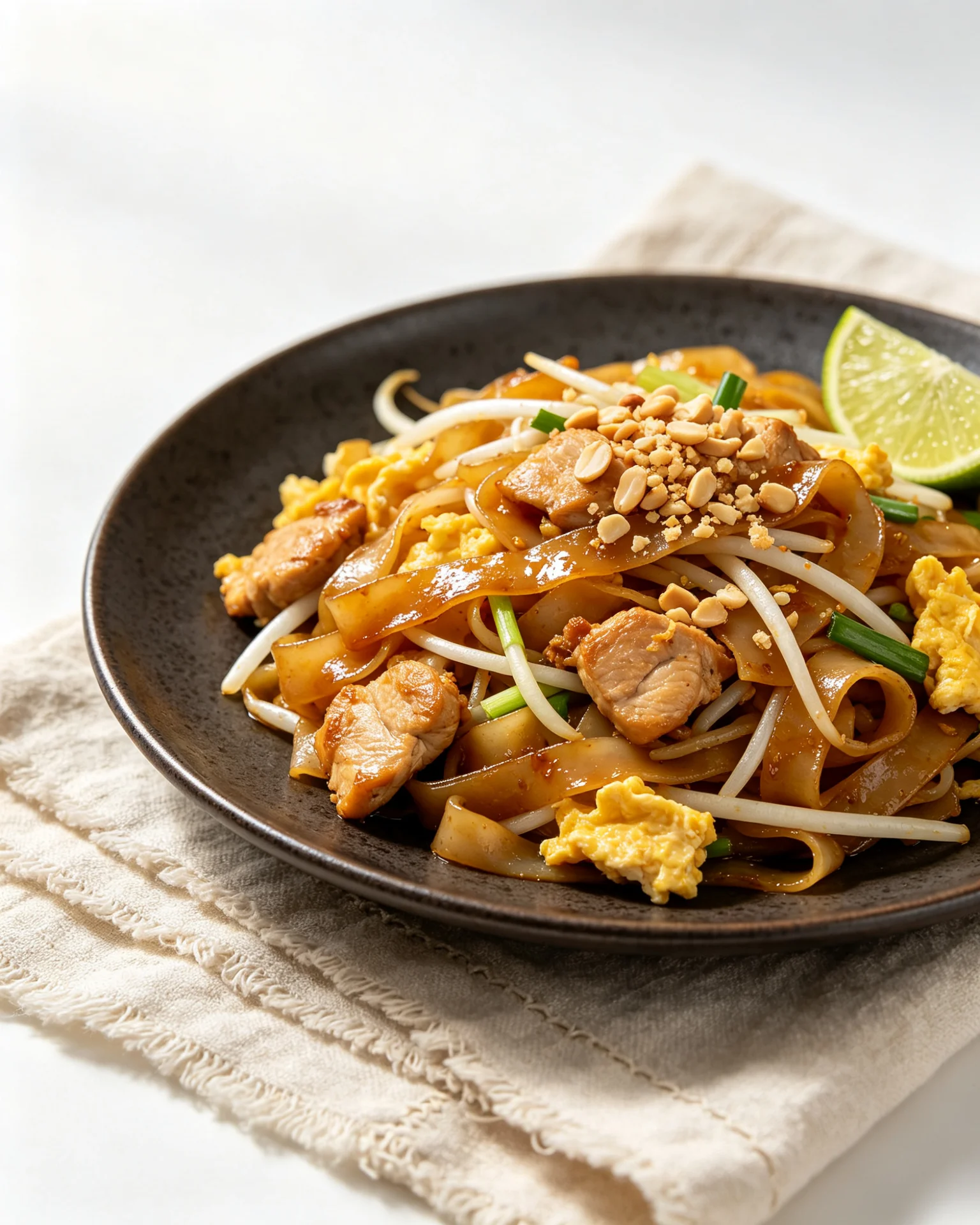
- Slide the steaming pad thai immediately onto a wide serving platter. Scatter the crushed roasted peanuts across the crown and mound the remaining fresh bean sprouts beside the noodles. Serve immediately with fresh lime wedges, dried chili flakes, and a small pinch of sugar on the side.
Love Thai food?
Check out my complete guide to Thai home cooking, pantry essentials, and techniques.
Frequently Asked Questions
Q: Why do my pad thai noodles turn into a sticky, clumped ball?
A: Noodle clumping happens when dried rice noodles are boiled rather than soaked, or when too many portions are cooked at once. Boiling over hydrates the rice starch, causing the noodles to shed sticky moisture that steams them together. Always soak noodles in room temperature water for forty minutes, and limit your cooking to two servings per batch so your wok stays scorching hot.
Q: Can I substitute ketchup or white vinegar for tamarind paste?
A: Bottled ketchup and white vinegar provide harsh, one dimensional acidity with excess artificial sweeteners. True pad thai relies on the deep, fruity tartness of tartaric acid found in tamarind pulp. Authentic seedless tamarind paste is readily available at Asian grocery stores and keeps for over a year in your refrigerator.
Q: What is the best protein to use in pad thai?
A: Juicy chicken thigh meat provides rich flavor that resists drying out over high heat. Large raw shrimp with tails on are the classic Bangkok street pairing. Firm yellow pressed tofu, thinly sliced pork loin, or pan seared beef also work wonderfully when cooked following the same high heat searing method.
Q: How do you reheat leftover pad thai without the noodles breaking?
A: Rice noodles turn brittle when chilled in the refrigerator. To reheat, warm one teaspoon of neutral oil in a hot non stick skillet over medium heat, add the cold noodles, and drizzle with two tablespoons of water. Cover the pan with a lid for ninety seconds to let trapped steam soften the rice starches, then toss gently until hot.
You might also like: Check out our complete Thai cooking guide for more essential ingredients and techniques.
Traditional Thai Chicken Pad Thai Recipe with Tamarind Glaze
PT20M
PT20M
PT40M
Ingredients
- 4 tbsp dense Thai palm sugar (chopped fine)
- 4 tbsp premium fish sauce
- 4 tbsp pure tamarind paste (pure seedless pulp)
- 3 tbsp clean water
- 120 g dried medium flat rice noodles (soaked in cold water for 40 minutes, drained)
- 200 g boneless skinless chicken thighs (sliced into thin bite sized strips)
- 2 tbsp neutral cooking oil (divided, peanut or rice bran oil)
- 3 cloves fresh garlic (finely minced)
- 2 small shallots (peeled and thinly sliced)
- 50 g extra firm yellow pressed tofu (cut into small batons)
- 2 tbsp preserved sweet salted radish (chai poh, rinsed and minced)
- 1 tbsp small dried shrimp (rinsed, optional)
- 2 large eggs (lightly beaten with a pinch of salt)
- 1 cup fresh crisp bean sprouts (washed and dried)
- 3 stalks Chinese garlic chives or scallions (cut into one inch batons)
- 3 tbsp roasted unsalted peanuts (coarsely crushed)
- 1 fresh juicy lime (cut into wedges)
- 1 tsp roasted Thai red chili flakes (for the table)
- 1 tsp granulated white sugar (for the table)
Instructions
Did you make this recipe?
Tag @asianfoodsdaily on Instagram or leave a comment below!
Testing Notes
Tested in Asha's kitchen. Last reviewed January 25, 2026.
Ingredient Substitutions
Substitution notes coming soon.
About Asha
Half Asian, half African cook raised between two food-obsessed cultures. I've spent 10 years learning Asian cooking traditions through family, friends, and thousands of hours at the stove — testing every dish until it works in a standard home kitchen.
Read my full storyTechnique & Pantry Guides
Related Recipes
More delicious dishes you might enjoy

-768.webp)


Loading comments...